Use of Lasers in the Operating Room
The implementation of the use of lasers in surgery has been ground-breaking. It has allowed for less invasive procedures, and has decreased post-operative complications and hospitalizations. But with great advancements also comes great responsibility. Perioperative nurses must have specialized training when using laser systems. This section of module 5 provides an overview of lasers. Nurses must be specifically trained on each laser along with its specific safety considerations before using them in the perioperative environment.
(Ball, 2019)
The Principle of Light
Use the acronym LASER to help remember the process of how light energy is produced:
What does this mean?
Laser devices use light to generate laser energy. Light is electromagnetic energy and can be measured as a wavelength on the electromagnetic spectrum.
(Ball, 2019)
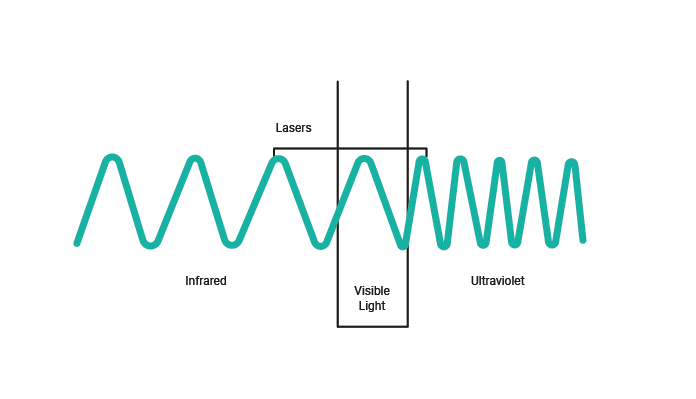
How Do Lasers Work?
All lasers consist of three elements:
- medium (atoms or particles)
- energy source (could be a chemical reaction, diode, or other source of energy)
- optical cavity (container of the medium, has a fully reflective mirror on one end and partially reflective mirror on the other end)
Inside the laser’s optical cavity there are several atoms/particles in their base or relaxed state. When an outside source of energy is introduced, these particles get excited. They always want to return to their base or relaxed state.
To do this, they must release a photon which is a small package of light energy. Photons travel in waves and encourage other atoms to return to their resting state to produce more photons. The photons bounce back and forth off mirrors that are inside the laser chamber. When activated, one of the mirrors allows select photons to leave the chamber and be directed at a specific site.
Watch this video for a quick overview of how a laser work:
Characteristics of a Laser’s Light
There are three distinct characteristics which make a laser’s light different from light we see daily. They are:
- Monochromatic light – The photons in the light are all the same wavelength/colour.
- Collimated – Meaning that the laser beam is made up of light waves that are parallel. Because the waves run parallel to one another, they can move quickly, do not lose speed, and can be concentrated into a small area.
- Coherent – All the light waves are working together in an orderly fashion and are all headed in the same direction. This may seem like a simple fact, but because of this, laser light waves have lots of power.
Laser power is measured in watts.
Possible Laser Interactions
Why use Lasers in the Operating Room?
- Lasers work well to seal vessels and tissue with fewer complications. This includes sealing small blood vessels with less blood loss, sealing lymphatics while helping to decrease postoperative edema, and sealing nerve endings.
- Lasers can help to sterilize tissue.
- Lasers can decrease the risk of stenosis.
- Lasers can target specific tissue without damaging surrounding tissues.
- Lasers are fast and can reduce operative time.
- Lasers can make procedures less invasive, allowing for some inpatient surgery to be done ambulatory.
- Lasers allow for less use of general anesthesia and more local/targeted anesthesia use.
- Patients often have a much quicker recovery time.
(Ball, 2019)