Pneumatic Tourniquet Uses in the Operating Room
Pneumatic tourniquets are used often in the OR when the surgical team would like to reduce or occlude blood flow to an extremity. Doing this provides the team superior visualization at the surgical site with an almost bloodless field while they operate. Pneumatic tourniquets are often used in orthopaedic and in plastic surgery limb cases.
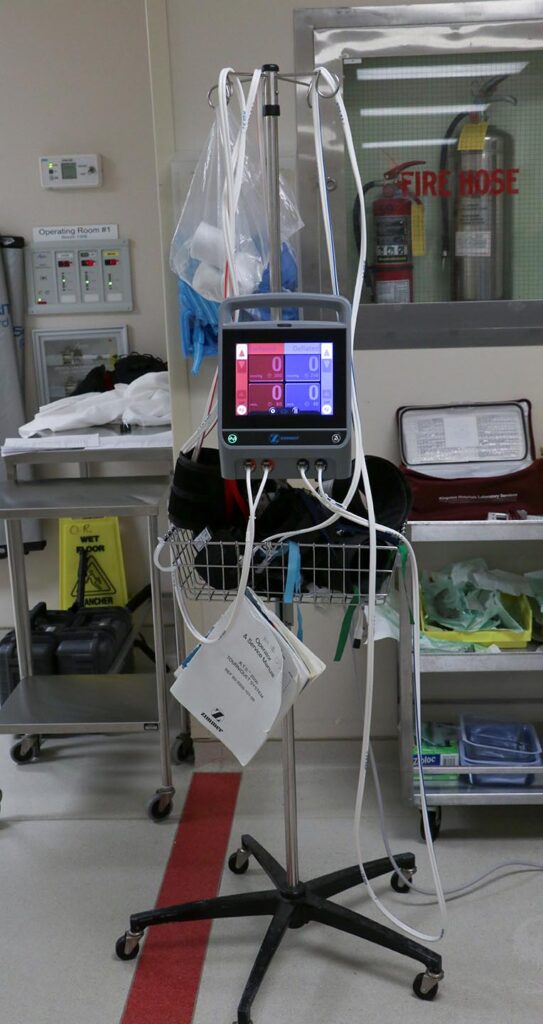
How does a Pneumatic Tourniquet work?
Before placing the tourniquet on a limb, it is important to select the appropriate size. The tourniquet site is protected with appropriate padding or stockinette (according to hospital policy).
The cuff should wrap around the limb and overlap by at least 3 inches. If the cuff is too short, it can come apart after being inflated. But it should not overlap more than 6 inches to avoid skin flaps from being pinched. The cuff should be wider than half the limb’s diameter to disperse pressure over a larger surface area.
The surgical team will check the systolic blood pressure. This is taken into consideration along with the patient’s age and the circumference of the extremity to set a specific pressure. Once the surgical team decides on the pressure settings, the circulating nurse will program the pneumatic tourniquet. The maximum pressure settings for a tourniquet on the thigh is 300-350mmHg. The maximum pressure settings for a tourniquet on the arm and lower leg is 250-300mmHg.
Before inflating the tourniquet, the surgical team will either use gravity by elevating the limb or will use an Esmarch elastic bandage to exsanguinate the limb.
The recommendation for a healthy adult is to not exceed 1 hour of constant tourniquet pressure on an upper extremity and not more than 2 hours on a thigh. For extended cases, the surgical team may need to allow the limb a rest by bringing the tourniquet pressure down and allowing revascularization.
(Bowen, 2019; ORNAC, 2021)
💬 Communication Highlight
It is vital that the perioperative team communicate when determining the set pressures for a pneumatic tourniquet. The anesthesia care provider can provide insight as to the patient’s systolic pressure and the team can determine the best settings for the tourniquet.
The circulating nurse must keep track of the time that the tourniquet is up. Many institutions have whiteboards where the tourniquet ‘time-up’ and ‘time-down’ can be clearly documented for all to see.
When deflating the tourniquet, it is vital that the circulating nurse communicate with the anesthesia provider. This is because deflation of the tourniquet can lead to hemodynamic changes and could reduce cardiac pre-load causing hypotension.
(ORNAC, 2021)
📁Documentation Highlight – Pneumatic Tourniquets
Pneumatic tourniquet use must be documented in the surgical record and must include the following:
- The location and size of the cuff
- The settings
- Who applied the cuff
- The serial number/model/unit number associated with the pneumatic tourniquet
- Times including inflation, deflation, and reinflation (if applicable)
- Notification to the surgeon of the elapsed time
- Skin condition at tourniquet site pre-op and post-op
📽️ AORN CINE-MED VIDEO
Navigate to the AORN Cine-Med website and make sure that you are logged in before clicking on the link below.
- Watch the AORN Cine-Med Video on: Pneumatic Tourniquet Safety
- Download the included Study Guide to follow along.
- (Thread to follow in Cine-Med – Equipment and product safety Pathophysiology and Risks of Pneumatic Tourniquet use)
- Runtime – 29 minutes