Types of Sponges
Sponges are used for several reasons during a surgical procedure such as absorbing fluid and blood, for the blunt dissection of tissue, for applying pressure or traction, and for protecting tissue. Sponges come in varied sizes and shapes.
(Phillips, 2020 & ORNAC, 2021)
Counting Sponges
Sponge Counting Requirements
- Sponges to be used during the procedure must be radiopaque. This is accomplished by a barium thread woven through them. Some insertions use an RFID tag in their sponges and towels.
- Sponges cannot be cut during the procedure as this increases the potential of losing a piece.
- Sponges must be counted in the increment they came in as packaged.
- Sponges must be counted twice before moving on to the next package to ensure there are no manufacturing errors.
- Sponges must be opened and counted separately.
- Laparotomy Sponges with a tape or tag need to be pull-tested to ensure they are secure.
Removing Sponges from the Sterile Field
- Soiled sponges should be placed in a designated container off the sterile field for retrieval by the circulating nurse.
- The perioperative RN counts and bag sponges in the same increment they were initially counted in.
- The bagged sponges must remain visible and in the OR until the end of the procedure, in case there is an incorrect count, and they need to be verified.
Small Dissecting Sponges (peanuts, kidners, etc.)
When used within a body cavity, these must be attached to an instrument, to reduce the chances of loss in the surgical wound.
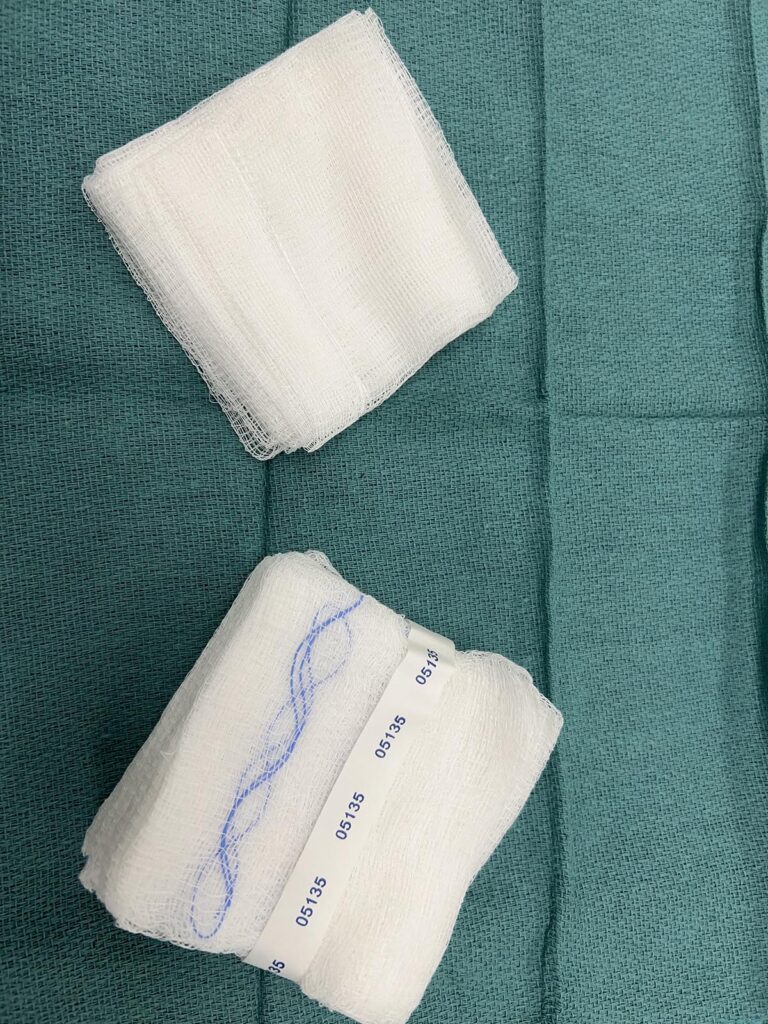
Radiopaque Gauze vs Dressing Gauze
Radiopaque Gauze | Dressing Gauze |
Comes in various sizes, 4×8 is most common | Comes in various sizes, 4×8, 2×2 |
Has X-ray detectable thread woven into the sponge | No X-ray detectable thread |
Used throughout a surgical procedure | Only to be opened when the surgical wound is closed |
Not used for post-op dressing | Only to be used for post-op dressing |
Sterile supply | Sterile supply |
Therapeutic Packing
- In some events, a sponge may be left in the wound intentionally. This is known as therapeutic packaging.
- Sponges used for therapeutic packing must be radiopaque.
- For therapeutic packing, the count is documented as incorrect with the number and type of sponge left in the wound. Personnel then follow their facility’s policy/procedure for further documentation.
Returning to the OR for removal of therapeutic packing
- Once the packing is removed, it should be taken from the sterile field.
- The number and type of sponges should be reconciled from the previous case documentation to ensure all sponges are removed from the patient.
- The count is documented as incorrect with the type and number of sponges removed from the surgical site identified clearly.
- For permanent wound closure, a thorough sweep of the wound must be completed followed by an X-ray to verify there are no retained sponges.
(ORNAC, 2021, Cromb, 2019 & AORN, 2022)