Specialty Instrumentation
There are numerous types of specialty surgical instrumentation and equipment that perioperative nurses must know how to handle and care for. This section covers commonly used ones.
Robotic Instruments
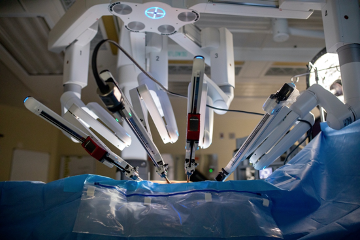
Since robotic surgery is a specialized type of laparoscopic procedure, the instrumentation is different. However, the tips are remarkably like laparoscopic instruments. For care and handling of robotic instruments, complete the Self-Study on Managing the reprocessing challenges of robotic instruments
Stapling Instruments
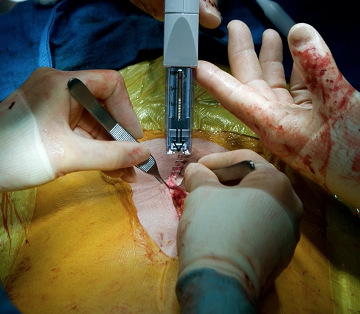
Stapling instruments deliver staples or clips to join, hold, and secure tissue. The most universally used type is the skin stapler which uses stainless steel or bioabsorbable staples. The skin stapler saves time as well as providing good cosmetic wound closure.
The use of staplers significantly decreases operating time and may shorten postoperative stays.
Another commonly used staple is a ligating clip or hemoclip that is used to clamp blood vessels and other structures (e.g., the common bile duct). They are available in varied sizes, are economical and easy to use. They replace the necessity for surgeons to clamp and tie off blood vessels as was done in the past. Scrub nurses mount a single staple at a time from the cartridge, and carefully pass the instrument to the surgeon so as not to dislodge the clip.
(Cromb, 2019)
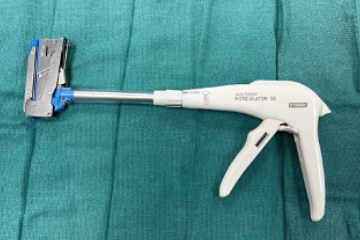
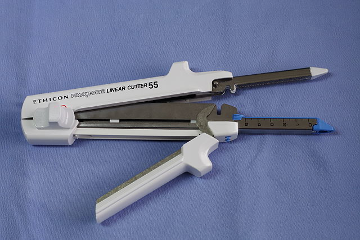
Surgical staplers use inert metallic staples that remain permanently in the tissue. Staplers are:
- primarily disposable
- pre-loaded, packaged, and sterilized by the manufacturer
- able to lay down staples in linear, or circular rows
- able to staple and resect parts of organs or tissues
- able to anastomose or join structures through stapling and cutting of tissues
- designed for use on various tissue types
- designed for open or minimally invasive surgeries
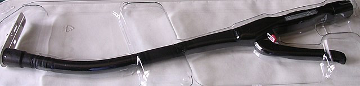
(Cromb, 2019)
📽️ Watch this Video
Watch this comprehensive video that reviews a variety of surgical staplers, their uses and the handling of the devices.
Surgical Stapler (11:35)
📁 Documentation Highlight
It is vital that the scrub nurse be aware of and communicate the number of staples that were implanted (left in the patient). Some surgeons may use a hemoclip temporarily and then remove it before the end of the surgical procedure. These are considered “wasted” or not implanted, as they are not left in the patient at the end of the case. The circulating nurse must confirm with the scrub nurse which staples were left in the patient and document this clearly, according to the facility policy.
Why is this so important?
Most surgical staples are MRI-compatible, but not all. It is vital to have this charted so that if a patient requires an MRI, the technician can look in the patient’s chart to ensure that all implanted staples are MRI-safe.
Powered Surgical Instruments
Power saws and drills are commonly used equipment in orthopedic, plastic, and other surgical specialties.
Characteristics of Power Tools
Characteristics of power tools used in the OR:
- The power source is compressed nitrogen, electricity, or batteries
- Safety controls prevent inadvertent activation
- Fingertip controls provide speed and power
- Drills and reamers make holes or ream channels in bone
- Power saw blades have multiple sizes and shapes and variable speeds
- Oscillating saw blades move back and forth in a vibrating motion
- Reciprocating saw blades move back and forth in a straight line
(Tighe, 2016)
Use of Power Tools in the OR
Nursing hints:
- Attach and test the instrument’s power supply before handing it to the surgeon
- Always activate the safety device before handing over the power tool
- Ensure point-of-use care to keep the tools clean
- Follow OR protocol in disposing of the sharp and individual-use components such as blades
- Follow the manufacturer’s recommendations for cleaning, lubricating, and sterilizing
(Cromb, 2019)
📽️ AORN CINEMED VIDEO
Navigate to the AORN Cine-Med website and make sure that you are logged in before clicking on the link below.
Watch Powered Surgical Instruments: Components of Safe Care and Handling.
- Download the included Study Guide to follow along.
- Care and Cleaning of Powered Surgical Instruments