Preventing Sharp Injuries
There is an increased risk of blood-borne pathogens when a sharps injury occurs. A multidisciplinary approach in the OR for sharps safety includes communication and teamwork. To prevent injuries scrub personnel should:
- Carefully set up sharps
- Be always aware of sharps and sharp’s locations
- Carefully dispose of sharps after the surgery
Safety-Engineered Devices
AORN has created a guideline for sharps safety and recommends perioperative personnel use safety-engineered devices including:
- Blunt-tip suture needles
- Safety scalpel devices
- Wound closure devices such as staples, tissue, skin adhesives, and/or skin closure strips
- Safety-engineered syringes and blades
- Blunt cannulas for withdrawing fluids and medications
- Needleless systems for collecting/withdrawing bodily fluids
Neutral Zones
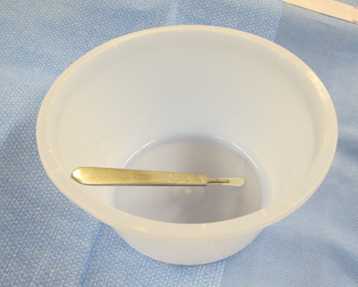
These are pre-designated areas on the surgical field where sharps are placed. Examples of neutral zones may be sterile basins, trays, or magnetic pads. The surgical team will place and retrieve a sharp from the neutral zone, then return it once used. The scrub personnel will then retrieve the item. By using this method there is no passing of sharps between two people, thus reducing accidental needle punctures or cuts.
Neutral zone risk-mitigating strategies:
- Communicate the agreed-upon neutral zone location before the procedure
- Communicate the location of sharps on the sterile field during the procedure
- Place one sharp at a time on the neutral zone
- Return the sharp to the neutral zone after use
- Orient the sharp for safe retrieval by the surgeon
- Have only one person at a time use the neutral zone
(Cromb, 2019)
No-Touch Technique
The no-touch technique is another component of the AORN’s Guidelines for sharps safety. This technique minimizes the handling of sharps, therefore reducing the risk of injuries.
This technique includes the following:
- Avoid manipulating the suture needle with gloved hands
- Use the suture package to position the needle
- Use a blunt instrument to guide the needle through the tissue
- Before tying a suture, remove the needle
- Turn a suture 90 degrees on the driver, using forceps (guarding) before returning the loaded needle driver to the neutral zone
- Use an instrument, not hands, to retrieve sharps that have fallen off the sterile field.
(Cromb, 2019)
Practice Controls in the Workplace
Changing the method of practice through workplace controls can reduce the risk of injury.
Work practice controls:
- Avoid using sharps instruments unless necessary
- Always use an instrument to load and remove the blade on the knife handles
- Use instruments, not hands, to retract tissue
- Avoid recapping needles. If a safe needle device is not available, use the one-scoop technique if recapping is required
- Use gauze or an ampule breaker before taking the top of an ampule off
(Cromb, 2019)
Personal Protective Equipment
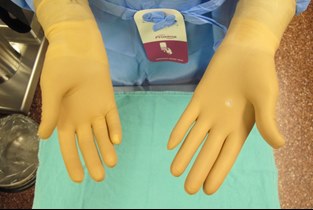
Intact sterile gloves protect both the patient and the person wearing them. However, the risk of glove failure increases when there is a tear or puncture. To reduce this risk, perioperative personnel should:
- Wear two pairs of gloves
- Check gloves for perforations
- Use a system that indicates perforations (e.g., a different-coloured bottom glove)
- Change the gloves if a suspected or actual perforation or visible defect occurs
(Cromb, 2019)
📽️ AORN CINE-MED VIDEO
Navigate to the AORN Cine-Med website and make sure that you are logged in before clicking on the link below.
- Watch the AORN Cine-Med Video on Sharps Safety. You can check out specific prepping methods for various procedures.
- Download the included Study Guide to follow along.
- (Thread to follow in Cine-Med – Patient and Worker Sharps Safety)
- Runtime – 17 minutes